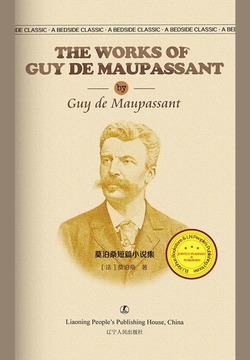
莫泊桑短篇小說集(英文版)
莫泊桑
1449人在讀
65.4萬字總字數
¥4.5定價
莫泊桑
居伊·德·莫泊桑,19世紀後半期法國傑出批判現實主義作家,短暫的一生中創作六部長篇小說、一部詩集、三部遊記和三百多篇中短篇小說,是位不折不扣的高產作家,被譽爲“短篇小說之王”。莫泊桑與契訶夫和歐·亨利齊名,被公認爲世界三大短篇小說巨匠,對後世影響深遠。其導師,《包法利夫人》的作者福樓拜,曾這樣指導莫泊桑進行“速寫”訓練:“當你走過一個坐在自家店門前的雜貨商,走過一個吸菸斗的守門人跟前,你給我描繪一下這兩個人的神情姿態,身體的外貌特徵。不但要用畫家的白描手法,還要描述他他們全部的精神本性,這樣,就使人不至於把他們和別的雜貨商和守門人混同起來。”莫泊桑掌握了這一要領。而這就是他的作品成功原因所在。
2025年3月20日 星期四 祝福早安 天氣晴朗 氣溫3℃《莫泊桑短篇小說集》 I was at the time twenty-five years of age, and I was making daubs along the coast of Normandy. I call "making daubs" that wandering about, with a bag on one's back, from mountain to mountain, under the pretext of studying and of sketching nature. I know nothing more enjoyable than that happy-go-lucky wandering life, in which one is perfectly free, without shackles of any kind, without care, without preoccupation, without thinking even of to-morrow. One goes in any direction one pleases, without any guide, save his fancy, without any counselor save his eyes. One pulls up, because a running brook seduces one, because one is attracted, in front of an inn, by the smell of potatoes frying. Sometimes it is the perfume of clematis which decides one in his choice, or the roguish glance of the servant at an inn. Do not despise me for my affection for these rustics. These girls have a soul as well as feeling, not to mention firm cheeks and fresh lips; while their hearty and willing kisses have the flavor of wild fruit. Love always has its price, come whence it may. A heart that beats when you make your appearance, an eye that weeps when you go away, are things so rare, so sweet, so precious, that they must never be despised. I have had rendezvoux in ditches in which cattle repose, and in barns among the straw, still steaming from the heat of the day. I have recollections of canvas being spread on rude and elastic benches, and of hearty and fresh, free kisses, more delicate and unaffectedly sincere than the subtle attractions of charming and distinguished women. But what one loves most amidst all these varied adventures is the country, the woods, the risings of the sun, the twilight, the light of the moon. These are, for the painter, honeymoon trips with nature. One is alone with her in that long and tranquil rendezvous. You go to bed in the fields, amidst marguerites and wild poppies, and, with eyes wide open, you watch the going down of the sun, and descry in the distance the little village, with its pointed clock tower, which sounds the hour of midnight. You sit down by the side of a spring which gushes out from the foot of an oak, amidst a covering of fragile herbs, upright and redolent of life. You go down on your knees, bend forward, you drink that cold and pellucid water which wets your moustache and nose, you drink it with a physical pleasure, as though you kissed the spring, lip to lip. Sometimes, when you encounter a deep hole, along the course of these tiny brooks, you plunge into it, quite naked, and you feel on your skin, from head to foot, like an icy and delicious caress, the lovely and gentle quivering of the current. You are gay on the hills, melancholy on the verge of pools, exalted when the sun is crowned in an ocean of blood-red shadows, and when it casts on the rivers its red reflection. And, at night, under the moon, which passes across the vault of heaven, you think of things, and singular things, which would never have occurred to your mind under the brilliant light of day. So, in wandering through the same country where we are this year, I came to the little village of Benouville, on the Falaise, between Yport and Etretat. I came from Fecamp, following the coast, a high coast, and as perpendicular as a wall, with its projecting and rugged rocks falling perpendicularly into the sea. I had walked since the morning on the shaven grass, as smooth and as yielding as a carpet. And singing lustily, I walked with long strides, looking sometimes at the slow and ambling flight of a gull, with its short, white wings, sailing in the blue heavens, sometimes on the green sea, at the brown sails of a fishing bark. In short, I had passed a happy day, a day of listlessness and of liberty. I was shown a little farm house, where travelers were put up, a kind of inn, kept by a peasant, which stood in the center of a Norman court, which was surrounded by a double row of beeches. Quitting the Falaise, I gained the hamlet, which was hemmed in by great trees, and I presented myself at the house of Mother Lecacheur. She was an old, wrinkled and austere rustic, who seemed always to succumb to the pressure of new customs with a kind of contempt. It was the month of May: the spreading apple-trees covered the court with a whirling shower of blossoms which rained unceasingly both upon people and upon the grass. I said: "Well, Madame Lecacheur, have you a room for me?" Astonished to find that I knew her name, she answered: "That depends; everything is let; but, all the same, there will be no harm in looking." In five minutes we were in perfect accord, and I deposited my bag upon the bare floor of a rustic room, furnished with a bed, two chairs, a table, and a wash-stand. The room looked into the large and smoky kitchen, where the lodgers took their meals with the people of the farm and the farmer, who was a widower. I washed my hands, after which I went out. The old woman fricasseed a chicken for dinner in a large fireplace, in which hung the stew pot, black with smoke. "You have travelers, then, at the present time?" I said to her. She answered, in an offended tone of voice: "I have a lady, an English lady, who has attained to years of maturity. She is going to occupy my other room." I obtained, by means of an extra five sous a day, the privilege of dining out in the court when the weather was fine. My cover was then placed in front of the door, and I commenced to gnaw with my teeth the lean members of the Normandy chicken, to drink the clear cider, and to munch the hunk of white bread, which was four days old, though excellent. Suddenly, the wooden barrier which gave into the highway, was opened, and a strange person directed her steps towards the house. She was very slender, very tall, enveloped in a Scotch shawl with red borders, and one might have believed that she had no arms, if one had not seen a long hand appear just above the haunches, holding a white tourist umbrella. The face of a mummy, surrounded with sausage rolls of plaited, gray hair, which bounded at every step she took, made me think, I know not why, of a sour herring adorned with curling papers. Lowering her eyes, she passed quickly in front of me, and entered the house. That singular apparition made me yearn. She undoubtedly was my neighbor, the aged English lady of whom our hostess had spoken. I did not see her again that day. The next day, when I had installed myself to commence painting, at the end of that beautiful valley, which you know, and which extends as far as Etretat, I perceived, in lifting my eyes suddenly, something singularly attired, standing on the crest of the declivity; one might indeed say, a pole decked out with flags. It was she. On seeing me, she suddenly disappeared. I re-entered the house at midday for lunch, and took my seat at the common table, so as to make the acquaintance of this old original. But she did not respond to my polite advances, was insensible even to my little attentions. I poured water out for her with great alacrity; I passed her the dishes with great eagerness. A slight, almost imperceptible movement of the head, and an English word, murmured so low that I did not understand it, were her only acknowledgments. I ceased occupying myself with her, although she had disturbed my thoughts. At the end of three days, I knew as much about her as did Madame Lecacheur herself. She was called Miss Harriet. Seeking out a secluded village in which to pass the summer, she had been attracted to Benouville, some six months before, and did not seem disposed to quit it. She never spoke at table, ate rapidly, reading all the while a small book, treating of some protestant propaganda. She gave a copy of it to everybody. The cure himself had received no less than four copies, conveyed by an urchin to whom she had paid two sous' commission. She said sometimes to our hostess, abruptly, without preparing her in the least for the declaration: "I love the Savior more than all; I admire him in all creation; I adore him in all nature, I carry him always in my heart." And she would immediately present the old woman with one of her brochures which were destined to convert the universe. In the village she was not liked. In fact, the schoolmaster had declared that she was an atheist, and that a kind of reprobation weighed down on her. The cure who had been consulted by Madame Lecacheur, responded: "She is a heretic, but God does not wish the death of the sinner, and I believe her to be a person of pure morals." These words, "Atheist," "Heretic," words which no one can precisely define, threw doubts into some minds. It was asserted, however, that this English woman was rich, and that she had passed her life in traveling through every country in the world, because her family had thrown her off. Why had her family thrown her off. Because of her natural impiety? She was, in fact, one of those people of exalted principles, one of those opinionated puritans, of which England produces so many, one of those good and insupportable old women who haunt the table d'hôte of every hotel in Europe, who spoil Italy, impoison Switzerland, render the charming cities of the Mediterranean uninhabitable, carry everywhere their fantastic manias, their petrified vestal manners, their indescribable toilettes and a certain odor of India rubber, which makes one believe that at night they slip themselves into a case of that material. When I encounter one of these people some fine day in a hotel, I act like the birds, who see a manakin in a field. This woman, however, appeared so singular that she did not displease me. Madame Lecacheur, hostile by instinct to everything that was not rustic, felt in her narrow soul a kind of hatred for the ecstatic extravagances of the old girl. She had found a phrase by which to describe her, a phrase assuredly contemptible, which she had got, I know not whence, upon her lips, invented by I know not what confused and mysterious travail of soul. She said: "That woman is a demoniac." This phrase, culled by that austere and sentimental creature, seemed to me irresistibly comic. I myself, never called her now anything else, but "the demoniac," exercising a singular pleasure in pronouncing aloud this word on perceiving her. I would ask Mother Lecacheur: "Well, what is our demoniac about to-day?" To which my rustic friend responded, with an air of having been scandalized: "What do you think, sir, she has picked up a toad which has had its paw battered, and carried it to her room, and has put it in her wash-stand, and dressed it up like a man. If that is not profanation, I should like to know what is!" On another occasion, when walking along the Falaise, she had bought a large fish which had just been caught, simply to throw it back into the sea again. The sailor, from whom she had bought it, though paid handsomely, was greatly provoked at this act, more exasperated, indeed, than if she had put her hand into his pocket and taken his money. For a whole month he could not speak of the circumstance without getting into a fury and denouncing it as an outrage. Oh yes! She was indeed a demoniac, this Miss Harriet, and Mother Lecacheur must have had an inspiration of genius in thus christening her. The stable-boy, who was called Sapeur, because he had served in Africa in his youth, entertained other aversions. He said, with a roguish air: "She is an old hag who has lived her days." If the poor woman had but known! The little, kind-hearted Celeste, did not wait upon her willingly, but I was never able to understand why. Probably, her only reason was that she was a stranger, of another race, of a different tongue, and of another religion. She was, in good truth, a demoniac! She passed her time wandering about the country, adoring and searching for God in nature. I found her one evening on her knees in a cluster of bushes. Having discovered something red through the leaves, I brushed aside the branches and Miss Harriet at once rose to her feet, confused at having been found thus, fixed on me eyes as terrible as those of a wild cat, surprised in open day. Sometimes, when I was working among the rocks, I would suddenly descry her on the banks of the Falaise like a semaphore signal. She passionately gazed at the vast sea, glittering in the sunlight, and the boundless sky empurpled with fire. Some times I would distinguish her at the bottom of a valley, walking quickly, with an English, elastic step; and I would go towards her, attracted I know not by what, simply to see her illuminated visage, her dried-up, ineffable features, which seemed to glow with interior and profound happiness. I would often encounter her also in the corner of a field sitting on the grass, under the shadow of an apple tree, with her little Bible lying open on her knee,which she looked at meditatively at the distance. I could no longer tear myself away from that quiet country neighborhood, being bound to it by a thousand links of love for its sweeping and soft landscapes. At this farm I was unknown to the world, far removed from everything, but in close proximity to the soil, the good, healthy, beautiful and green soil. And, must I avow it; there was something besides curiosity which retained me at the residence of Mother Lecacheur. I wished to become acquainted a little with this strange Miss Harriet, and to know what passed in the solitary souls of those wandering old, English dames.
讀《莫泊桑短篇小說集》 重讀莫泊桑,對於耳熟能詳的“羊脂球”與“項鍊”等作品已無感,尤其是“項鍊”那種過分離奇的敘事,跟自然主義的書寫風格差異甚大。不過讀到“蠻子大媽”一篇還是感覺到作者的藝術手法,冷靜的敘述,貼近地氣的自然流淌,呈現一種慢的力量。這個故事並沒有被作者講述成爲一個敵方士兵爲非作歹,我方大媽英勇放火燒敵的庸俗愛國故事。反而是敵方四個士兵對“蠻子大媽”很好,打水做家務,簡直有如人民子弟兵。但當蠻子大媽得知自己的兒子在前線的噩耗後,開始籌劃復仇,最終燒死四個普魯士士兵。這種寫法,並非簡單的善惡美醜,而是呈現了人性之複雜。蠻子大媽的復仇跟國家情懷與正義與否沒有任何關係,她的仇恨建築在個人的好惡之上,復仇者的最終是一座墳地。結尾,面對德國軍官,蠻子大媽冷靜地說:“您將來要寫起這件事的來由,要告訴他們的父母說這是我乾的。我在孃家的名姓是威克多娃·西蒙,到了夫家旁人叫我做蠻子大媽。請您不要忘了。”在莫泊桑冷靜緩慢的敘述筆調裏,故事格外令人驚心動魄,甚至感覺到一種從骨子裏升起的寒意。作爲世界三大短篇小說之王的莫泊桑,短篇自然佳作甚多,但他的長篇小說,有心人亦不可忽視。《一生》、《漂亮朋友》在寫實裏夾雜自然主義的描寫手法,真正是好小說的寫作路數。譬如《一生》裏寫到:“人這一生,既不像想的那麼好,也不像想的那麼壞。”這就是人生,千百年來始終如此。至於《漂亮朋友》,傳統評論僅僅着眼於它的批判性,還是小說功利主義的餘毒。其實《漂亮朋友》之偉大,不在於批判性,而是它的寫實與虛構的完美融合,把生活的另一面栩栩如生地展現在我們面前,冷靜,剋制。不過法國批評家羅蘭•巴爾特對莫泊桑一類的作家不以爲然,認爲他們屬於“規約性的寫作”。然而多年以後,我還是記得蠻子大媽的愛與恨,多麼鮮明,又多麼令人不可捉摸。 戰爭的殘忍,對人性的毀滅與戕害,這一切都是漢語世界所陌生的,我們歌頌的乃是小兵張嘎、劉胡蘭,董存瑞,黃繼光,邱少雲等等戰爭裏的英雄。豈不知,乃知兵者是兇器,聖人不得已而用之。