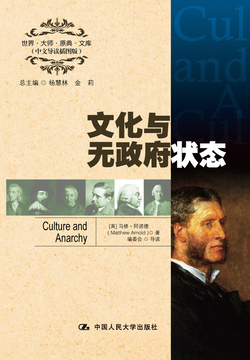
文化與無政府狀態(世界·大師·原典·文庫(中文導讀插圖版))
馬修·阿諾德
429人在讀
33.5萬字總字數
¥13.8定價
馬修·阿諾德
《文化與無政府狀態》一書中,作者把維多利亞時代的英國人分稱爲野蠻人(貴族)、非利士人(中產階級)和羣氓(平民),嚴厲抨擊了他們的自滿、庸俗和拜金主義,倡導以美與智的文化。通過閱讀、觀察和思考通向天道和神的意旨來對抗隨心所欲、我行我素的個人主義與工業主義所導致的缺乏秩序、準則和方向感的無政府狀態,以期實現“文化、人性整體和諧、全面發展的完美”,從而確立國家的觀念、集體的最優秀的自我,和民族的健全理智。
文化,看看Williams的大衆立場,也看看Anorld的精英立場
The author wrote this book to criticize the tradition in Englishmen which promotes individualism and personal liberty to override the collective good and generalized reason. At that time, enntering into the nineteenth century, the intellectual center in Europe had shifted from England to Germany. We all know Kant, Hegel, Marx, together with Austrian intellectuals, the german speaking genius has dominated the Europe of nineteenth century. So the author was deeply worried that Englishmen will be surpassed by Germans through the good education and state policy directd by good reason he described in this book. And the tricky thing is now we know that Anglo Saxon tradition thrived longer than which German has, it might just because the deep cultural essence he has described in this book, that personal liberty, conservative skepticism to the government to the common good to the collective interests is deeply rooted in the Englsh culture. It is that culture which prevented the UK going into the radical revolution that predicted by karl Marx or ignited by Fascism. In the long run, the German model failed. Back to the culture he described. It is a tendency toward human perfectionism which combines the jewish christianity faith and Hellenic philosophical thinking. The culture has two major functions still useful today. First It will not let us rivet our faith upon any one man and his doings. It makes us see not only his good side, but also how much in him was of necessity limited and transient. Secondly, culture tries to float our stock habits of thinking and acting to prevent their being stiff and stark pieces of pertifaction any longer. Why English American tradion prevailed, why eastern empires and other empires all failed, the reason might be found in the culture.
From the perspective of intellectuals, this paper criticizes three kinds of British people in the social transformation period at that time: barbarians (nobles), Philistines (middle class) and mobs (civilians), and puts forward the idea of saving the country by culture and beautiful and bright reading thinking to lead to heaven and God's will, so as to fight against anarchy caused by individualism. It's somewhat vague.Strong religious color, and disagreeable views. In the words of Raymond Williams, Matthew Arnold is a thinker who lost his fulcrum in the transitional period.So under this opportunity, an ideal concept of "culture" was created.Or "sour romantic" Overview & Ideas In the first article,Arnold explained his understanding of "culture" - "Culture is the pursuit of perfection. Its motivation is not knowledge or, first of all, scientific enthusiasm for pursuing pure knowledge, but also moral enthusiasm and social enthusiasm for doing good." In fact, in the whole book, Arnold has always emphasized the relationship between culture and perfection and harmony. He regards culture as the highest rationality and can surpass any defects or limitations of human beings to guide human beings to move forward: "Perfection should ultimately be the harmonious development of all the abilities that constitute the beauty and value of human nature..." He distinguished this culture from culture in a narrow sense: "Culture not only strives to understand and learn the way of God, but also strives to put it into practice so that it can pass through the world, so that the moral, social and charitable character of culture will be revealed." Then, Arnold criticized the British fashion of mechanical and material civilization at that time for a long time. He stressed that people should clearly distinguish processes (or tools) from goals, and clearly identify the substantive relationship between the two - what should be pursued as the ultimate goal, and should not just be trapped in tools, but respect tools. Target worship objects. Next is the tools for specific comments to be targeted: railways and coal, wealth, population and body, etc., and then point out that the ideals of life should be beautiful, bright and perfect ideals that are perfect in all aspects and worth pursuing with all their strength. However, in the final summary, due to the limited level, I don't quite understand it very well - I understand the relationship between the pursuit of goals and tools, but Arnold's repeated so-called "beauty and light", isn't that perfect concept a little abstract or nothing? At least, tools are specific and insightable things. For the pursuit of tools, because the goal is clearer, it is easier to determine what they pursue without getting lost. I think this may also be the reason why people worshipped goals at that time; concepts such as beauty, light and perfection, which are highly summarized through words, people How should we grasp it? In the end, what measure can measure whether people have completed their pursuit? This is a little doubt left by me. In the second article, Arnold mainly criticized the general tendency of the British to emphasize personal freedom at that time, and the "light" derived from the first article, which also refers to the role of "reason". The lack of reason leads to the lack of goals and direction - "Our popular concept is that for a person, it is the luckiest and most important. It's just to be able to do whatever you want. As for what people should do when they have the freedom to do whatever they want, we don't attach much importance to it. In Arnold's view, even "freedom", which has been regarded as the highest pursuit by countless people in history, is regarded as a "tool": "We advocate freedom itself, freedom for freedom, we believe in tools, and anarchy is manifesting." There is no denying that Arnold's words are really critical and have led me to think about what "freedom" is - which seems to be really not accurately mentioned in the "freedom" praised in the past - what is after being free? People praise the lofty of freedom in the absence of freedom. For many people, is it really just an expression of a desire for what is not available? No matter what this "unavailable thing" is, it can ultimately be attributed to the lack of freedom - the lack of freedom to obtain it (as a tool). From this perspective, if freedom becomes a tool, its value will be greatly reduced - Arnold is really reasonable. At the same time, we can also clearly read Arnold's firm opposition to anarchy. In the last Conclusion, "Whoever manages this society, no matter how much we want to drive them away and prevent them from continuing to manage, as long as they are still in office, we must support it firmly and wholeheartedly. Hold them to stop the spread of anarchy and chaos. This is because without order, there is no society, and without society, there is no perfection of human beings. His view on "solving problems": "The 'authoritative' principle we seek to combat anarchic tendencies is the light of sound judgment, thought and reason." Arnold went on to explain his definition of the state, its indispensable position as a tool to avoid anarchy, and the need for culture and "excellent self" to guide the country when suppressing anarchy. In the third article, Arnold focuses on the comments of three sectors of society - he named the aristocracy, the middle class and the working class Barbarians, Philistines and Populace respectively. Arnold believes that the "barbarians" aristocracy represent "beauty" and lack "brightness" - "Generally speaking, the aristocracy culture is mainly external culture, and its main composition still seems to be external charm and attainments, as well as superficial inner virtues; the only shortcoming of the perfection of this class is the lack of sufficient. The light of reason." As for the "Polithian" middle class, Arnold's words are full of criticism - "Our middle class not only do not pursue beauty and light, but also like tools... I often mention that these contents constitute their gloomy and narrow-minded life." Finally, the evaluation of the "rogue" working class is mixed - "Sects of the working class act diligently in accordance with Mrs. Gucci's golden rules... For those members of the working class who seem to really contribute to great goals, we can appropriately classify them among the Philistines"; But in the end, there is a huge part of the working class" refers to those rough social strata, from which the term "gaoligans" also comes from. After commenting on each class separately, Arnold still did not forget to add that "under the distinction between social classes, there is still a common foundation of human nature. In fact, everyone has the tendency and passion to shape our compatriots into other classes." At the same time, everyone also has the potential to transform into other classes. In the fourth article, Arnold talks about two spiritual norms of human beings, or the way of thinking and code of conduct - the Hebrew spirit and the Greek spirit. In the article, Arnold mainly discusses the differences between the two spirits. "Behind the Greek and Hebrew concepts is the inherent desire to follow the will of heaven and God and pursue a universal order". The difference is that "the dominance of the Hebrew spirit is the solemn conscience, and the most important thing is behavior and obedience; and the Lord of the Greek spirit. Guidance is the spontaneousness of consciousness, and the most important concept is to see the true nature of things. Arnold believes, "The world should have struck a balance between the two poles, but in fact it has never done so." In the article, we can also see that Ah himself seems to be inclined to the Greek spirit. Then, he explored in depth the relationship between the Hebrew spirit and Christianity, and the influence of the former on the latter. Arnold pointed out, "The British still have strong Hebrew characteristics in real life and moral behavior: self-confidence, persistence and concentration (this is the embodiment of Puritan spirit"). Therefore, he advocated that the British should introduce more Greek spirit to reconcile the excessive proportion of the Hebrew spirit. In fifth and sixth article, Arnold further explores the above-mentioned issues of beauty and light, the Greek spirit and the Hebrew spirit. On the basis of the previous article, he discussed the religious, political, social phenomena and current reviews at that time and specifically combined his personal position. It is difficult to understand and comment on these backgrounds that I don't know much about. In a word, the general tone of culture and anarchy is to advocate the pursuit of perfection, rational culture and the best self to control the tendency of anarchy. "The way out seems to be culture; culture can not only lead to perfection, but only through culture that we can we have peace."
Please check 〈culture and anarchy〉 (佚名!)@0.99