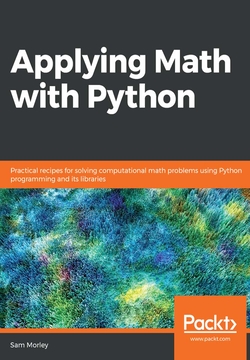
Applying Math with Python
Sam Morley
121人在讀
43.8萬字總字數
¥54.49定價
Sam Morley
Python, one of the world's most popular programming languages, has a number of powerful packages to help you tackle complex mathematical problems in a simple and efficient way. These core capabilities help programmers pave the way for building exciting applications in various domains, such as machine learning and data science, using knowledge in the computational mathematics domain.The book teaches you how to solve problems faced in a wide variety of mathematical fields, including calculus, probability, statistics and data science, graph theory, optimization, and geometry. You'll start by developing core skills and learning about packages covered in Python’s scientific stack, including NumPy, SciPy, and Matplotlib. As you advance, you'll get to grips with more advanced topics of calculus, probability, and networks (graph theory). After you gain a solid understanding of these topics, you'll discover Python's applications in data science and statistics, forecasting, geometry, and optimization. The final chapters will take you through a collection of miscellaneous problems, including working with specific data formats and accelerating code.By the end of this book, you'll have an arsenal of practical coding solutions that can be used and modified to solve a wide range of practical problems in computational mathematics and data science.
一刷 The second edition of Applying Math with Python contains the following content: It reviews the core areas of mathematics and introduces basic packages, tools and libraries in the Python scientific stack, such as numpy, scipy and matplotlib. It explains how to use matplotlib to achieve basic mathematical plotting, including operations such as changing the plotting style and adding labels. It also covers more advanced topics such as calculus, probability and networks (graph theory), enabling readers to master the probability theory of Bayesian inference and Markov Chain Monte Carlo (MCMC) methods, and gain a deep understanding of the core concepts of applied mathematics, demonstrating how to use Python to solve optimization problems in the real world and apply mathematical knowledge to practical scenarios.
這本書介紹了 Python 科學計算的方方面面,但每個方面並沒有深入介紹。這本書有它的獨到之處,可以和張若愚的《Python 科學計算》互相參考來讀。