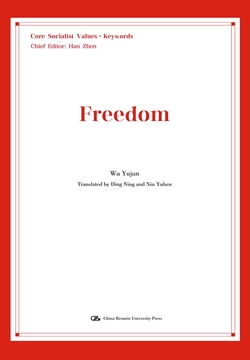
自由(英文版)(社会主义核心价值观·关键词)
韩震 吴玉军
62人在读
18.9万字总字数
¥70.8定价
韩震 吴玉军
自由是人发展的目的,在共产主义的初级阶段社会主义,自由也理所当然是个人发展和社会建设的目的。中华民族的近代史特别是中国共产党成立以来的中国近代史,在很大程度上也是一部中国人民和中华民族争取自由的历史。生产资料的社会公有制,决定了广大劳动者在社会主义社会才能享有真正的自由。本书以此为理论依据,介绍了自由的一般意义,自由对于国家、社会和个人发展的作用,并在最后说明,在中国特色社会主义的伟大事业中,个人自由与国家建设、社会发展是高度统一的。本书是社会主义核心价值观关键词“自由”的英文版。
2024年10月9日 星期三 祝福早安 天气多云 气温12℃ 《自由》 《自由就在乌云背后》 你在我心里 种下一棵树 你的话语是种子 你浇灌你看顾 树苗慢慢长 果子慢慢结 可惜好景它不长 乌云遮盖了我成长 你就躲在乌云背后 跟我捉迷藏 你是我天上的父亲 我太过调皮 有一天 你会驾着云彩降临 你说清心的人能看见 自由就在乌云背后 …… Freedom:Shared Value of Humanity Seeking freedom is an inborn nature of human beings.People's pursuit of freedom is like enjoying sunlight and breathing air.Freedom is a fundamental right and characteristic of humanity.Individuals with freedom are emancipated from shackles of the outside world and thus are free from slavery and control by other people, have an independent will and freedom of action.They can fully exhibit and develop their individual character in line with their interests and hobbies to achieve all-round development.Throughout the history of humanity, the pursuit of freedom has been a constant theme.Human history, in fact, is a history of pursuing freedom.Countless people with lofty ideals from every corner of the world have sacrificed their lives for freedom and“freedom”has become one of the most appealing words in our vocabulary. Human History:A History of Pursuing Freedom Freedom is a topic that is both old and new, both simple and complex.Throughout the course of history, freedom has been discussed and debated by numerous people, with countless literature work dedicated to this topic.People hold different attitudes toward freedom.Someone sing the praises of freedom.In his well-known poem Love and Freedom, Petöfi Sándor, a Hungarian poet, expressed his praise and longing for freedom. Life is dear, love is dearer. Both can be given up for freedom. Some people, however, harbor a deep feeling of rancor about freedom.Madame Roland, a French politician, who spent a lifetime fighting for liberty and her ideals but was conveyed to the guillotine in the name of liberty, uttered the famous remark for which she is remembered before her execution: Oh! Liberty, what crimes are committed in thy name! Some consider freedom as the highest value of life while some see it as a heavy burden; some regard freedom as a God-given and inborn right, still some think freedom needs to be tirelessly pursued; some say freedom means people can act at their will in an unstrained manner; others argue that we need rules and standards—freedom cannot exist without laws and regulations.Montesquieu, a French philosopher, said in his book The Spirit of the Laws: There is no word that has admitted of more various significations, and has made more different impressions on human minds, than that of Liberty. Georgi Plekhanov, a Russian philosopher, said:“The question of freedom is like Sphinx asks every thinker:Solve my riddle, or I will devour you! ” The complexity of the concept of freedom indicates that an abstract and simple understanding and interpretation of freedom is not desirable.Freedom is, in essence, a historical concept—people living in different times or standing on different positions have different understandings of freedom.It can only be correctly understood and interpreted through close review of its historical circumstances.For the sake of brevity, detailed analysis of its historical formation is not made in this book.The following contents only offer a brief summary of the development of the concept of freedom. 1.1.1 Ancient Athens:Freedom of Citizens under Democracy To understand the west, we need to examine the thoughts of the ancient Greece.Engels said in his book On Dialectics: The manifold forms of Greek philosophy contain in embryo, in the nascent state, almost all later modes of outlook on the world. Theoretical natural science is therefore likewise forced to go back to the Greeks if it desires to trace the history of the origin and development of the general principles it holds today.And this insight is forcing its way more and more to the fore. Thoughts that are related to freedom are also included in the“later modes of outlook on the world”.Ancient Greek political thoughts and practices represent the beginning of western consciousness of freedom and development of political freedom. When people from other places were in the status of barbarism or under the authoritarian rule of slave owners or feudal lords, ancient Athenians already began the earliest democratic political practice in human history.In ancient Athenian politics, free citizens could take part in the administration of the city and freely express their views.Each free citizen is independent from other free citizens.They“exercised collectively, but directly, several parts of the complete sovereignty; in deliberating, in the public square, over war and peace; in forming alliances with foreign governments; in voting laws, in pronouncing judgments; in examining the accounts, the acts, the stewardship of the magistrates; in calling them to appear in front of the assembled people, in accusing, condemning or absolving them.” Pericles, arguably the most prominent and influential Greek statesman, orator and general of Athens during the Golden Age, proudly spoke of the political system in Funeral Oration: Our constitution does not copy the laws of neighbouring states; we are rather a pattern to others than imitators ourselves. Its administration favours the many instead of the few; this is why it is called a democracy.If we look to the laws, they afford equal justice to all in their private differences; if no social standing, advancement in public life falls to reputation for capacity, class considerations not being allowed to interfere with merit; nor again does poverty bar the way, if a man is able to serve the state, he is not hindered by the obscurity of his condition.The freedom which we enjoy in our government extends also to our ordinary life.There, far from exercising a jealous surveillance over each other, we do not feel called upon to be angry with our neighbour for doing what he likes, or even to indulge in those injurious looks which cannot fail to be offensive, although they inflict no positive penalty.But all this ease in our private relations does not make us lawless as citizens.Against this fear is our chief safeguard, teaching us to obey the magistrates and the laws, particularly such as regard the protection of the injured, whether they are actually on the statute book, or belong to that code which, although unwritten, yet cannot be broken without acknowledged disgrace. Background Information Ecclesia The ecclesia was the principal assembly of the democracy of ancient Athens and had the highest authority.It was held 40 times every year. The assembly was responsible for examining and approving proposals drafted by Boule, the council, reviewing and electing the public officials.All citizens could attend the assembly and had the rights to know, speak, vote and stand for election.All free citizens were both ruler and the ruled. In ancient Athens, most public officials were elected by lot and the term was one year.No one could hold the position for more than two terms.All free citizens, from illiterate farmers to rich people, might be elected, even being the highest leader of the city. Freedom of citizens under democratic politics in Athens is a landmark in human history.In ancient times, when people from other parts of the world were in the stage of barbarism or under the authoritarian rule of slave owners or feudal lords, in Greece, for the first time in history, some of the residents enjoyed citizenship, collectively owned and governed the state and developed democracy.This is of great significance in human history. However, democratic politics of Athens was not perfect.Only a minority of all residents enjoyed freedom.In the political structure of ancient Greece, people were divided into four strata:slaves, women, metics(resident aliens with no political rights)and citizens.Only citizens enjoyed freedom.These citizens constituted a very small part of the population, accounting for about one tenth of all the residents. Slaves, who were the majority of the population, were regarded merely as“tools that can talk”; they had no liberty, not to mention the right to take part in politics.“Private property and ‘liberty'of the Greeks, as it were, cannot be separated from slavery, because slave trade was their most important business.The flourishing of their liberty is based on the flourishing of slavery.In the heyday of Athens, on average, an adult male citizen had 18 slaves and more than 2 metics or released slaves.”[插图] Political freedom and democracy were not accessible to women, either.The responsibilities of women were childbearing and household labor.They were not allowed to take part in politics. Meanwhile, freedom in the era of ancient Athens is greatly different from that of modern times.In modern society, freedom is a legitimate right of citizens, namely people's right to act freely and without limitations as long as they do not break the law.The opposite of freedom is restricting people's will and action through means such as violence, slavery and menaces.In ancient Athens, the modern concept of freedom—“having an independent space free from control of authoritarian forces”—does not exist.Compared to other countries with despotism, ancient Athenians enjoyed independence from other people, including the ruler; however, citizens were not independent from the city.In ancient Greece, life of citizens was highly dependent on the city.The small territory of the city-state and the exclusion of the group of citizens led to the tight-knit community inside the city and the unique mentality of citizens.People regarded themselves as an integral part of the city and thought their personal wealth, family, interests, honor, hope, physical and spiritual life and even their souls after death belonged to the city.As a result, all aspects of citizens'private life were politicized.Social equity, personal happiness and satisfaction of desires were defined and influenced by the city-state.The extensive intervention in people's lives by the mighty city-state was a defining feature of the politics of ancient Greek city-states. The city controlled every aspect of social life.The result was the absence of a clear boundary between citizenship and public authority. All things related to citizens were influenced by the power of the city-state.Therefore, there were no individuals in the sense of political rights; there were only individuals in the physiological sense.Citizens did not develop objectives, hobbies and needs based on private interests and they were dominated by a collective consciousness of the citystate.Every citizen clearly knew that they belonged to the city-state. Although Socrates, who was known for his maverick opinions, saw himself as“a gadfly of Athens”, he had very strong loyalty and attachment to the city-state.This is clearly demonstrated by his reply to Crito's pleas to attempt an escape from prison. Has a philosopher like you failed to discover that our country is more to be valued and higher and holier far than mother or father or any ancestor, and more to be regarded in the eyes of the gods and of men of understanding? Also to be soothed, and gently and reverently entreated when angry, even more than a father, and if not persuaded, obeyed? And when we are punished by her, whether with imprisonment or stripes, the punishment is to be endured in silence; and if she leads us to wounds or death in battle, thither we fol low as is right… In ancient Greeks'eyes, it was natural that citizens should unconditionally obey orders of the city-state.They did not believe that the city-state was a free combination of will of individuals.The formation of the concept of freedom—individuals are free from threat of any outside force, including other individuals, the state, society, and the development of the concept of individualism took place in the west only in modern times. 1.1.2 The Bourgeoisie:Seeking Happiness and Individual Rights In the Middle Ages, Europe was for a long time shrouded in the darkness of slavery and Feudalism.Dominated by the two upper echelons of the social structure, the nobility and the clergy, Europeans did not have access to democracy, freedom or human rights.People's words and deeds were strictly controlled by the Catholic Church. People holding different opinions from the church would be labeled as heretics and sentenced by the Inquisition. Background Information Inquisition The Inquisition was a group of institutions within the judicial system of the Roman Catholic Church in the Middle Ages and early Renaissance, whose aim was to combat heresy.The Inquisition stifled progressive ideas, with many victims being scientists of the time.The total number of people put on trial by inquisitorial courts throughout their history was approximately 380,000.During the 150 years after the 15th century, 30,000 people were executed in Rome, the center of the rule of the Catholic Church.Bruno, an Italian scientist, was imprisoned in 1592 because he criticized scholasticism and theology.He was sentenced by the Institution and burnt at the square called Campo de'Fiori(meaning in English:Field of Flowers)in 1600. Three events marked the transition of humanity from agrarian culture to industrial culture:discovery of new shipping routes, the Renaissance and the Protestant Reformation.Industrial civilization is so far the most dynamic and innovative civilization in human history. In several hundred years, people created far more physical and spiritual wealth than all preceding generations together.Karl Marx and Friedrich Engels said in the Communist Manifesto: The bourgeoisie, during its rule of scarce one hundred years, has created more massive and more colossal productive forces than have al l preceding generations together.Subjection of nature's forces to man, machinery, application of chemistry to industry andagriculture, steam navigation, railways, electric telegraphs, clearing of whole continents for cultivation, canalization or rivers, whole populations conjured out of the ground—what earlier century had even a presentiment that such productive forces slumbered in the lap of social labor? Secularization movement gained momentum along with the development of productive forces and expansion of human interaction.The emerging bourgeoisie dismissed rules and disciplines set by the Christianity and enjoyed the worldly life.To fight feudal monarch and theocracy, the bourgeoisie upheld freedom, equality and human rights and believed that individuals had a range of rights that were protected by laws.Liberation of thoughts and individual freedom were pursued by the bourgeoisie. 伟大心灵的祷告10月9日 田莱顿师母 全能的神,我们称颂赞美祢,因为我们再醒来,看见另一日地上生活的光亮。我们该想今天应作的事。我们的年月是祢的,让它们为祢所用。我们的日子有限,让我们谨慎使用。这些黑暗的日子在我们背后,求祢赦免那些日子的罪恶。在前面还有阴暗的日子,求祢加力得胜试炼。求祢今日照亮我们,这一天是我们的。我们必须好自为之,在日常的工作上有乐趣。求祢指示我们责任所在,帮助我们忠心去作。我们一切所作的都作得好,蒙祢悦纳。求祢赐我们力量工作,赐忍耐承受,赐勇气持久。当我们厌烦的时候,提醒我们这是祢的工作,使我们因爱祢,看不可爱的事,也透过祢爱的光照。阿们!