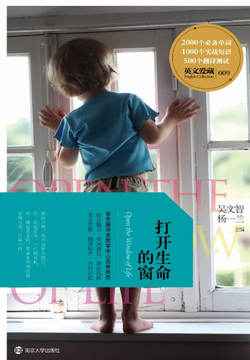
英文愛藏:打開生命的窗
吳文智 楊一蘭
610人在讀
21.7萬字總字數
¥19.9定價
吳文智 楊一蘭
人生於世,不過是匆匆過客。急急流年,滔滔逝水。生命中沒有什麼恆久不變的風景。我們的理智使我們一次次看透人生,我們的激情又使我們一次次重受矇蔽。生命原本就是一場得失共存的行走,既然來走了這一遭,那就千山萬水,隨意行去。透過這一篇篇的哲理故事,打開通向靈魂的窗戶,在一花一木中抵達生命的豁然之境。作爲雙語讀物,《打開生命的窗》爲中英雙語對照版,既是英語學習愛好者、文學愛好者的必備讀物,也是忙碌現代人的一片憩息心靈的家園,讓讀者在欣賞原法原味和凝練生動的英文時,還能多角度、深層次地品讀語言特色與藝術之美,再配合文章後附加的多功能、全方位鞏固題型,更有助於理解並學習英文。
2022年5月6日 星期五 祝福早安 天氣晴朗 氣溫18℃ 《打開生命的窗》 一生最大的收穫 Catch of a Lifetime 佚名 / Anonymous He was 11 years old and went fishing every chance he got from the dock at his family’s cabin on an island in the middle of a New Hampshire Lake. On the day before the bass season opened, he and his father were fishing early in the evening, catching sunfish and perch with worms. Then he tied on a small silver lure and practiced casting. The lure struck the water and caused colored ripples in the sunset, then silver ripples as the moon rose over the lake. When his peapole doubled over, he knew something huge was on the other end. His father watched with admiration as the boy skillfully worked the fish alongside the dock. Finally, he very gingerly lifted the exhausted fish from the water. It was the largest one he had ever seen, but it was a bass. The boy and his father looked at the handsome fish, gills playing back and forth in the moonlight. The father lit a match and looked at his watch. It was 10:00 p.m. —two hours before the season opened. He looked at the fish, then at the boy. “You’ll have to put it back, son.” he said. “Dad!” cried the boy. “There will be other fish.” said his father. “Not as big as this one.” cried the boy. He looked around the lake. No other fishermen or boats were anywhere around in the moonlight. He looked again at his father. Even though no one had seen them, nor could anyone ever know what time he caught the fish, the boy could tell by the clarity of his father’s voice that the decision was not negotiable. He slowly worked the hook out of the lip of the huge bass and lowered it into the black water. The creature swished its powerful body and disappeared. The boy suspected that he would never again see such a great fish. That was 34 years ago. Today, the boy is a successful architect in New York City. His father’s cabin is still there on the island in the middle of the lake. He takes his own son and daughters fishing from the same dock. And he was right. He has never again caught such a magnificent fish as the one he landed that night long ago. But he does see that same fish again and again—every time he comes up against a question of ethics. For, as his father taught him, ethics are simple matters of right and wrong. It is only the practice of ethics that is difficult. Do we do right when no one is looking? Do we refuse to cut corners to get the design in on time? Or refuse to trade stocks based on information that we know we aren’t supposed to have? We would if we were taught to put the fish back when we were young. For we would have learned the truth. The decision to do right lives fresh and fragrant in our memory. It is a story we will proudly tell our friends and grandchildren. Not about how we had a chance to beat the system and took it, but about how we did the right thing and were forever strengthened. 他11歲那年,一有機會就到新漢普郡湖心島上他家的小屋碼頭釣魚。 在鱸魚季節來臨的前一天,他和父親傍晚很早就開始準備了。他們用小蟲做誘餌來釣太陽魚和鱸魚。他在銀色的釣鉤上放好誘餌,開始練習拋線。釣鉤撞到水面上,在夕陽中蕩起一片金光閃閃的水波。月亮升起來時,水波就變得銀光閃閃。 當釣竿彎下去的時候,他知道線的那一端一定釣到了一條大魚。他靈巧地在碼頭邊沿和那條大魚周旋。父親用讚賞的眼神關注着他。 最後,他很小心地將那條筋疲力盡的魚從水裏拉了出來。這可是他所見過的最大的一條魚,而且還是條鱸魚。 男孩和他的父親凝視着這條漂亮的魚,它的鰓在月光下一張一翕。父親點燃一根火柴,看了一下表。現在是10點——離鱸魚季節的開放時間還有兩個小時。他看了看魚,又看了看兒子。 “你要把它再放回去,兒子。”他說。 “爸爸!”男孩喊。 “還會有其他魚的。”父親說。 “但肯定不會像這條一樣大。”男孩喊道。 他看了看湖的周圍。月光下,周圍沒有其他漁民或船隻。他再一次看着父親。儘管並沒有人看着他們,也沒有人知道他們是什麼時候釣到魚的,但從父親那堅定的聲音中,男孩知道這個決定是不容更改的。他慢慢地將釣鉤從大鱸魚的脣上拿下來,然後蹲下來把那條魚再放回水裏。 那條魚擺了擺強健的軀體,消失在水裏。男孩懷疑他再也不可能看到那麼大的魚了。 那件事已經過去34年了。而今,男孩已經成爲紐約城裏一位成功的建築師。他父親的小屋仍然佇立於湖心島上。他也曾帶着自己的兒子和女兒回到同一個碼頭去釣魚。 他當時的猜想是對的。他再也沒有見過那麼大的魚了,就像很久以前的那天晚上所釣到的那樣。但是,在他每次面對道德難題時,那條大魚總會浮現在他的眼前。 因爲正如父親告訴他的那樣,道德就是簡單的對和錯的問題,困難的是付諸行動。在無人旁觀時,我們的行爲能否仍然正當?爲了將圖紙及時送到,我們是否會抄近路?或者在明知不應該的情況下,我們是否會將公司股份賣掉? 當我們年輕的時候,如果有人要讓我們把魚放回去,我們應該那樣去做,因爲我們將從中學到真理。選擇去做正確事情的決定將在我們的記憶裏變得深刻而清晰。我們可以把這個故事自豪地講給我們的朋友和後輩聽。這並不是關於如何攻擊某種體制並戰勝它,而是關於如何去做正確的事情,從而不斷完善自己。 道德就是簡單的對和錯的問題,困難的是付諸行動。在無人旁觀時,我們的行爲能否仍然正當?當我們年輕的時候,如果有人要讓我們把魚放回去,我們應該那樣去做,因爲我們將從中學到真理。 I was waiting in line to register a letter in the post office at 33rd Street and 8th Avenue in New York. I noticed that the clerk appeared to be bored with the job—weighing envelopes, handing out stamps, making change, issuing receipts—the same monotonous grind year after year. So I said to myself: “ I am going to try to make that clerk like me. Obviously, to make him like me, I must say something nice, not about myself, but about him. So I asked myself, what is there about him that I can honestly admire?” That is sometimes a hard question to answer, especially with strangers; but, in this case, it happened to be easy. I instantly saw something I admired no end. So while he was weighing my envelope, I remarked with enthusiasm: “I certainly wish I had your head of hair.” He looked up, half-startled, his face beaming with smiles. “Well, it isn’t as good as it used to be,” he said modestly. I assured him that although it might have lost some of its pristine glory, nevertheless it was still magnificent. He was immensely pleased. We carried on a pleasant little conversation and the last thing he said to me was: “Many people have admired my hair.” I’ll bet that person went out to lunch that day walking on air. I’ll bet he went home that night and told his wife about it. I’ll bet he looked in the mirror and said: “It is a beautiful head of hair.” I told this story once in public and a man asked me afterwards: “What did you want to get out of him?” What was I trying to get out of him!!! What was I trying to get out of him!!! If we are so contemptibly selfish that we can’t radiate a little happiness and pass on a bit of honest appreciation without trying to get something out of the other person in return—if our souls are no bigger than sour crab apples, we shall meet with the failure we so richly deserve. Oh yes, I did want something out of that chap. I wanted something priceless. And I got it. I got the feeling that I had done something for him without his being able to do anything whatever in return for me. That is a feeling that flows and sings in your memory long after the incident is past. There is one all-important law of human conduct. If we obey that law, we shall almost never get into trouble. In fact, that law, if obeyed, will bring us countless friends and constant happiness. But the very instant we break the law, we shall get into endless trouble. The law is this: Always make the other person feel important. John Dewey, as we have already noted, said that the desire to be important is the deepest urge in human nature; and William James said: “The deepest principle in human nature is the craving to be appreciated.” As I have already pointed out, it is this urge that differentiates us from the animals. It is this urge that has been responsible for civilization itself. Philosophers have been speculating on the rules of human relationships for thousands of years, and out of all that speculation, there has evolved only one important precept. It is not new. It is as old as history. Zoroaster taught it to his followers in Persia 2,500 years ago. Confucius preached it in China 2,400 years centuries ago: “Do unto others as you would have others do unto you.” 有一次,在紐約第8大街第33街區的一個郵局裏,我正在排隊寄一封掛號信,無意間發現那位負責收寄掛號信的工作人員看起來對工作很厭煩的樣子——稱信、取郵票、找零、開收據……他年復一年地重複着這些單調乏味的動作。 於是,我暗暗對自己說:“我一定要讓這個人注意我。顯然,讓他注意我,我就一定要對他說一些讚美的話——不是關於我的,而是關於他的。”於是,我問自己:“他身上有哪些東西值得我稱讚呢?” 有時,這樣的問題很難有答案,特別是在面對一個陌生人的時候。然而,巧合的是,我一眼就發現了他身上值得我稱讚的地方。這樣一來,事情就變得簡單多了。 於是當他爲我稱信時,我熱情地對他說:“我真希望能有像您這樣的好頭髮。” 聽了我的話,他抬起了頭,顯得有些喫驚,臉上還露出一絲由衷的微笑。 “不過,現在沒有原來好了。”他很謙虛地說。 我真誠地對他說,儘管頭髮的光澤或許比以前稍差了點,不過看上去依然很不錯。他顯得非常高興,我們開心地聊了起來。最後,他對我說:“許多人都曾誇獎過我的頭髮。” 我相信,他那天喫午餐的時候肯定是心情歡暢的;我相信,他晚上回家後,肯定會跟他的妻子講起這件事;我還相信,他會站在鏡子前欣賞着自己的頭髮,並由衷地說上一句:“我的頭髮多漂亮啊!” 我曾經在一個公開場合講過這個故事。故事講完後有個人問我:“您希望從他那裏得到些什麼呢?” 我想從他那裏得到些什麼!!!我想從他那裏得到些什麼!!!假如我們都是如此自私,做什麼事情唯一的目的就是貪圖他人的回報,那麼我們就不會給他人帶去一絲快樂,就會吝於給他人一句真誠的讚美。如果我們的靈魂如此卑微,那麼陪伴我們的只會是失敗和沮喪,絕不是成功和幸福。 是的。我確實想從那個人的身上得到某種東西,某種珍貴無價的東西。最終,我也確實得到了。我得到了這種感覺,在不求回報的前提下,做了一件讓他感到高興的事情。這件事過去以後,我仍會時常想起……
thanks so much, there are many articles or websites for ways of learning english. but a book in a real english version is not easy to be availed.
Many essays reappear here in this selection, and a few vocabulary still remain unfamiliar to me. repeation is Power , thanks to the editor Who offers so much to the reader.
人生於世,不過是匆匆過客,急急流年,滔滔逝水,生命中沒有什麼恆久不變的風景
你們的朋友可以嗎。今天上午是真的喜歡了這麼好熱熱到底吧?你要知道你喜歡哪個角色i斤斤計較斤斤計較呢!額額好開心😃i?沒看美劇看不懂得到
Marvelous articles