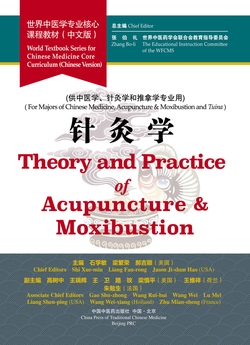
鍼灸學(世界中醫學專業核心課程教材)
田磊
2061人在讀
43.2萬字總字數
¥219.5定價
田磊
本套叢書由張伯禮會長、世界中聯教育指導委員會擔任總主編,由1本教學大綱和13本教材組成,主編會議、編寫會議、審稿會、定稿會分別已於2015年3月、5月底以及2016年1月、6月在北京舉行,由世界中聯教指委和我社聯合舉辦,我社具體承辦,費用由天津中醫藥大學資助的出版費承擔。按照《世界中醫學本科教育標準》要求編寫。編寫人員由世界中聯教指委和我社聯合在世界範圍精心遴選的來自海內外頂級中醫藥院校和機構的具有豐富教材編寫經驗和國際化教學經驗的一線、一流頂級專家、學者,來自15個國家和地區的74所高等中醫藥院校及研究院(所),合計283人,其中境內34個機構、226人;境外40個機構,57人。英文版教材已陸續編輯加工、出版。現申報的中文版教材內容有國際化特色,強調規範性、實用性、安全性,部分內容爲國內教材所缺,如潔針技術等。海外華人中醫從業者衆,且學習中文的外國人日衆,與該套教材的英文版配套,很有必要。市場需求和前景較好。兩個效益均佳。《中醫內科學》由張伯禮、吳勉華、林子強主編。 作者簡介:張伯禮,男,中國工程院院士,中國中醫科學院院長,天津中醫藥大學校長、教授、博導。國家重點學科中醫內科學科帶頭人,並從事中藥現代化研究。兼任中華中醫藥學會副主任委員,中國中西醫結合學會副會長,教育部高等學校中醫學教學指導委員會主任委員,973首席科學家。爲20餘種國家級核心期刊主編/副主編/編委。主編專著十餘部,發表論文120餘篇。獲國家科技進步獎3項(含一等獎),國家發明獎1項、省部級科技一、二等獎22項。主持完成的“中成藥二次開發核心技術體系創研及其產業化”榮獲國家科技進步一等獎。《方劑關鍵科學問題研究》,創建了以中藥組分配伍研製現代方劑的新模式及配伍優選設計方法,達國際先進水平。主持的子課題獲國家科技進步二等獎。主要代表作:《津沽中醫名家學術要略》《今日腦病》《中藥不良反應與合理用藥》《中醫內科學》《中醫內科學(案例版)》《中成藥臨牀合理使用讀本》《中醫藥高等教育發展戰略研究》《複方丹蔘方的現代研究——組分配伍研製現代中藥的理論與實踐》《天津中醫藥史略與學術思想》等。
Luo Zhen (Stiff Neck) Luo Zhen is a condition characterized by sudden pain and restricted movement in the neck, primarily referring to acute simple neck stiffness and pain. It falls within the category of neck soft tissue injuries and is also known as "lost pillow" or "lost neck." In Western medicine, Luo Zhen is often seen in individuals with a history of cervical spondylosis or those who have experienced muscle protective contraction due to certain neck injuries and joint sprains. The occurrence of Luo Zhen is commonly associated with improper sleeping posture, inappropriate pillow height, excessive neck load, and invasion of wind-cold pathogenic factors into the neck and back. The underlying pathogenesis is damage to the sinews, acute contraction of the meridians, and obstruction of the flow of qi and blood. Whether it is improper posture, excessive load, or invasion of wind-cold, all can lead to acute contraction of the neck meridians and obstruction of the flow of qi and blood. The affected area of this disease is the neck sinews, which are closely related to the Du Meridian, the hand and foot Taiyang meridians, and the foot Shaoyang meridian. Key Points for Syndrome Differentiation • Main Symptoms: Stiffness and pain in the neck, restricted movement, and obvious tenderness in the nape or neck and shoulder area. • Du Meridian and Taiyang Meridian Type: Severe pain in the nape and back, which worsens when bending the head forward, with obvious tenderness in the nape and back. • Shaoyang Meridian Type: Pain in the neck and shoulder area, with the head tilted to the affected side, and obvious tenderness in the neck and shoulder area. Treatment 1. Basic Treatment • Therapeutic Principle: To dredge the meridians, relax the sinews, and relieve pain. Acupuncture is mainly applied to local acupoints, combined with distal acupoints along the meridians. • Main Acupoints: Ah Shi points, Tianzhu (BL10), Houxi (SI3), Xuanzhong (GB39), and Wailaogong. • Supplementary Acupoints: For the Du Meridian and Taiyang Meridian type, add Dazhui (GV14) and Shugubone (BL11); for the Shaoyang Meridian type, add Fengchi (GB20) and Jianjing (GB21). • Formula Explanation: The foot Shaoyang and hand Taiyang meridians run through the neck area. Xuanzhong and Houxi belong to these two meridians respectively. Combined with local Tianzhu and Ah Shi points, the combination of local and distal acupoints can regulate the flow of qi and blood in the neck meridians, relax the sinews, and relieve pain. Wailaogong, also known as the "stiff neck point," is an empirical acupoint for treating this condition, with the functions of activating blood circulation, dredging the meridians, and relieving spasms and pain. • Manipulation: Insert the needle vertically into Tianzhu by 1 transverse finger width, Houxi by 0.5 transverse finger width, Xuanzhong by 0.5 transverse finger width, Wailaogong by 0.5 transverse finger width, and Ah Shi points by 1 transverse finger width. Use the twisting and discharging method. First, insert the distal acupoints and continue to twist the needle while instructing the patient to slowly move the neck. The pain can usually be relieved immediately. Then, insert the local acupoints and apply moxibustion or bloodletting if necessary. 2. Other Treatments • Digital Acupuncture: Select the Chengshan (BL57) on the affected side. The physician uses the thumb to press deeply until a local soreness and distension is felt. While pressing, instruct the patient to move the neck. This method is suitable for the initial stage of the disease. • Auricular Acupuncture: Select the neck, cervical vertebrae, and Shenmen points. Use moderate stimulation with filiform needles and instruct the patient to slowly move the neck area while continuously manipulating the needles. • Cupping Therapy: Select Dazhui (GV14), Jianjing (GB21), Tianzong (SI11), and Ah Shi points. For severe pain, bloodletting cupping or sliding cupping can be performed.
這本教材講得太好了!內容豐富卻淺顯易懂易學,讓我們小白級中醫文化愛好者,讀了此書也能解決一些小病小痛之類的了,不管是對自己保健養生還是益助他人都很大收穫。