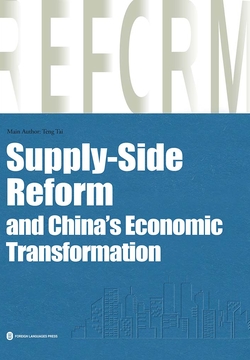
供给侧改革与中国经济转型(英文)
滕泰等
10人在读
19.2万字总字数
¥54定价
滕泰等
本书以供给侧结构性改革为切入点,梳理了这一改革与中国经济转型的关系。作者汇集数位著名经济学家,从供给侧改革的视角出发,聚焦改革中的不同要点,分析这一改革与中国经济转型之间的关系,向国际社会介绍中国经济转型中供给侧改革的进展。
供给侧改革与中国经济转型(英文)(4/4,Part3-C6~Appendix) 2) Carry out new measure→encourage soft indus dev. 3) Introduce new countermeasure→guard against risk in soft indus. Risk feature in diff indus: - industrial society: periodic recessions and inflation. - soft indus: vulnerable to the changes in group cognition and expect, indus value change: ✖️ continuously, ✔️ intermittently. 3. Encourage people to find job in soft indus→to deal the impact of AI on job. 1) gov establish job statistical method ~ soft employ. 2) publicize soft employ chance, explore new employ policy for soft indus. 3) social aid & population manage adapt new employ trend. 4. CN dev soft resources to take lead in global soft value creation. 1) soft recourse dev incl GDP accounting. 2) gov strengthen fin & tax support for soft resource dev. 3) gov, law, company deal w/ relation: soft resource protection & sharing. 4) company know: dev, process, repetitive use of soft resource. 5) gov build new biz environment system, make breakthrough in building soft environment. Chapter 7 3SR and Upgrade Consume 3SR & consumption upgrading→r 2 sides of the same issue. CN has new consumption demand but lack goods supply due to: 1) indus Trf & upgrade; 2) people’s diversified demand in new era. It lacks new consume that can stimulate inno. Echelon of mass consume in CN Ec dev: - 1st: people’s basic needs(4)— clothing, good, housing, transportation. → face bottleneck now—consume is saturated. - 2nd: (4)—healthcare, education, entertainment, elderly care. It’s in dire need→ spur Ec↑, Trf & upgrade 1st echelon. Reform is liberating productivity. Neosupply: core of productivity liberalization= ease supply restrict, lift supply suppression, promote 3SR. 1. healthcare indus - basic problem is insufficient supply. - underlying reason: intervention, excess regulate from gov. → high threshold of the indus→can’t fully dev. 2. education indus Many companies r building automated factories. But problem: workers need training to be professional. → upgrade education system→emerge institutions—1) training: vocational, language; 2) education: arts, sports. 3. entertainment indus The fastest-growing consume field w/ large room for dev worldwide. ↑ points: sightseeing tours, sports, movies, TV programs, theme parks, cultural & creative products. eg: Many scientists & engineers work in Hollywood, where tech & equipment r advanced > in indus. But CN TV & film can hardly foretell & guide future like Hollywood. Entertainment indus is rich like human’s spiritual world. Film, TV, sports, drones r leading the trend. 4. elderly care indus Since reform & open up, CN undergone 3 domestic consume Trf—aim diff consume groups: women, youth, elderly Ec. Dev of 2nd echelon will prompt 1st one. eg: 1) functional clothe. 2) cold chain logistics & manor Ec. 3&4) theme parks: residential airparks or recreational vehicles combining housing, transport, entertain. Appendix: Neosupply Economics Declaration I. Keynesianism and monetarism take turns misguide CN 1. K theory: base on 3 hypotheses: 1) ↓MC, 2) ↓marginal propensity to consume, 3) monetary liquidity preference. → If all correct, then a periodic shortage will occur. → gov use fiscal & monetary policy→ stimulate demand→ ↑ Ec & employ. 2. Monetarism: all inflation r caused by currency issues. →once price index > comfort zone, then gov constrict money supply. If use the 2 theories, whenever Ec growth↓, gov use fiscal & monetary policy to stimulate Ec. However, reality is converse. Repeat the 2, then CN Ec cycle will be shorter gradually. CN Ec drivers are: vitality of population, urbanization, constant invest of capital & resources, tech ↑, insti improve. Only when currency supply> excess capacity, can it cause general price levels↑. II. Supply creates wealth, new supply creates new demand K theory only exist in traditional indus in traditional Ec. As to fledgling Ec like CN, and factor↑ will: prevent marginal propensity to consume↓, ↑MC, change monetary liquidity preference→push forward evolution of S-D. demand = condition to realize value supply create wealth, = fountain of Ec↑. 5 SW r the basic impetus for Ec↑. III. Give full play to SW CN’s high-speed ↑ in the part 40 yrs manifest the 3 theories: 1. Smith: insti reform in 1980s. 2. Kuznets: growth by 5 SW in 1990s. 3. Schumpeter: CN will enter a new Sch growth period— destructive creation of tech & insti will = Ec growth impetus. Neosupply ≠ Neoliberalism. Neosupply economics believes: 1. source of agricultural wealth →is constrained by→ ecological environment, plant ↑ rules, people's physiological needs. 2. source of indus hard wealth →is restricted by→non-ecological resources & people's needs. 3. growth potential of SW— knowledge, info, fin products→is unlimited. Neosuplly economics support: eliminate monopoly & ctrl— reform SOEs, unleash growth potential, privatize property right, ↑quality of population. Conclusion: 1. see CN’s long-term ↑ potential from perspective of SW.→ neosupply economics. 2. gov: ✖️short-term manage, ✔️mid- & long-term issue in Ec operation. 3. ✖️full liberalization, ✔️stimulate new supply to create new demand. 4. relax monopoly & ctrl; ↑Ec liberal, privatize property right. 5. ↓ gov spend, ✖️structural tax ↓,✔️ largescale tax ↓. 6. start Ec insti & political system reform, give full play to all SW.
🗓日期 :2024/07/21(後補) 📕課程: 中信直播《把握經濟新風向》 [咖啡]關鍵詞:滕泰老師 [蛋糕]方程式: 經濟潛在發展=民企+政府消費轉民用+科技賦能+服務業國際競爭力 1/國內大循環市場的核心,關鍵是國民收入與就業的持續提升? 2/服務業的發展是促進農業與製造業,三個產業相互成就,每個產業總量增長、品質提升與國際競爭力才是發展關鍵? 3/我國出口產業要從產業鏈去配套,不能粗暴低價競爭,如光伏產業前些年增長喜人,而近年卻同質化競爭而大幅虧損? 4/消費佔GDP47%,其中政府高達17%左右而剩下的才是居民消費,今後是否有機會把政府消費轉換為居民消費? 5/如果還要搞市場經濟的話,民營經濟就很重要,否則只有國有經濟內部交易是無法計量與競爭的? 6/民營經濟發展確實有一些問題,都是成長中的煩惱,民營經濟最大貢獻是完成了家庭70%左右成員的就業,為安居樂業做出底層貢獻? 7/科技是我國經濟進步的重要因素,如互聯網對服務業、出口製造與農業營銷都做出了增值服務,退而廣之,AI也將是新的社會進步? 8/我們看事務要看本質,穿衣不再是遮風擋雨,汽車不再是追求速度,我們要從客戶角度與場景考慮商品的價值? 9/張瑞敏先生走進董宇輝直播間,承認軟價值創新? 10/大企業通過改變人類生活方式來進行顛覆創新,如微信、Chatgpt? 11/小企業創新還是微完善、增值服務? 12/創新來源於企業的投資體量、能量、生產流程、流量與服務閉環。
全新的财富理论,将财富划分为三大类:农业生态财富、工业硬财富和软财富,分析各类财富特点:农业生态财富的源泉受制于地球表层生态环境、动植物生长规律、人们的生理需求等约束,其增长前景是有限的;同时认为工业硬财富源泉因为受到地球非生态资源和人们的需求限制,其增长前景也是有限的;只有知识产品、信息产品、文化产品、金融产品及服务为代表的软财富增长空间是无限的。在农业生态财富和工业硬财富的领域,无视供给和需求约束,盲目扩张生产必然造成产能过剩、资源浪费、环境不可持续等问题,只有大力发展软财富,增加新供给,才能不断优化供给结构、创造新需求,引导经济进入供给、就业、需求、创新互相促进、不断优化的良性循环。