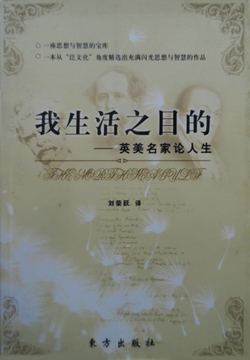
我生活之目的:英美名家論人生
劉榮躍 編譯
97人在讀
19.5萬字總字數
¥15.62定價
劉榮躍 編譯
一本從“泛文化”角度精選出的充滿閃光思想與智慧的作品英美名家關於人生社會的通俗讀物。
超出期望,作爲碎片化的閱讀不錯,對拓寬視野有好處。
2024年3月27日 星期三 祝福早安 天氣多雲 氣溫12℃ 《我生活之目的》 真正的高貴 True Nobility In a calm sea every man is a pilot. 在風平浪靜的大海上,每個人都是領航員。 But all sunshine without shade, all pleasure without pain, is not life at all.Take the lot of the happiest - it is a tangled yarn.Bereavements and blessings,one following another, make us sad and blessed by turns. Even death itself makes life more loving. Men come closest to their true selves in the sober moments of life, under the shadows of sorrow and loss. 但只有陽光沒有陰影,只有快樂沒有痛苦,根本不是真正的生活。就拿最幸福的人來說,他的生活也是一團纏結在一起的亂麻。痛苦與幸福交替出現,使得我們一會悲傷一會高興。甚至死亡本身都使得生命更加可愛。在人生清醒的時刻,在悲傷與失落的陰影之下,人們與真實的自我最爲接近。 In the affairs of life or of business, it is not intellect that tells so much as character, not brains so much as heart, not genius so much as self-control, patience, and discipline, regulated by judgment. 在生活和事業的種種事務之中,性格比才智更能指導我們,心靈比頭腦更能引導我們,而由判斷獲得的剋制、耐心和教養比天分更能讓我們受益。 I have always believed that the man who has begun to live more seriously within begins to live more simply without. In an age of extravagance and waste, I wish I could show to the world how few the real wants of humanity are. 我一向認爲,內心生活開始更爲嚴謹的人,他的外在生活也會變得更爲簡樸。在物慾橫流的年代,但願我能向世人表明:人類的真正需求少得多麼可憐。 To regret one's errors to the point of not repeating them is true repentance.There is nothing noble in being superior to some other man. The true nobility is in being superior to your previous self. section of the last chapter “Epilogue” of Lin Yutang's My Country and My People, published in New York by the John Day Publishing Company, 1935. 《生活的目的》是林語堂所著《吾國與吾民》最後一章《結語》的第一部分,該書由紐約的約翰·戴出版公司1935年出版。 Lin Yutang,林語堂(1895-1976), Chinese philologist and author. His My Country and My People has won for him both in America and England the reputation of being one of the ablest interpreters of China and her civilization. 林語堂(1895—1976),中國語言學家、作家。因《吾國與吾民》一書在美國和英國聲譽鵲起,躋身中國及中國文明的最佳闡釋者之列。 The End of Life 生活的目的 In the general survey of Chinese art and Chinese life, the conviction must have been forced upon us that the Chinese are past masters in the art of living. There is a certain whole-hearted concentration on the material life, a certain zest in living, which is mellower, perhaps deeper, anyway just as intense as in the West. 在概述了中國的藝術與生活之後,我們不得不承認中國人的確是精通生活藝術的大師。他們全心全意地致力於物質生活,其熱忱決不下於西方,並且更爲成熟,或許還更爲深沉。 In China the spiritual values have not been separated from the material values, but rather help man in a keener enjoyment of life as it falls to our lot. This accounts for our joviality and our incorrigible humor. 在中國,精神的價值並未與物質的價值相分離,反而幫助了人們更好地享受自己命定的生活。這就解釋了爲什麼我們具有一種快活的性情和根深蒂固的幽默。 A heathen can have a heathenish devotion to the life of the present and envelop both spiritual and material values in one outlook, which it is difficult for a Christian to imagine. We live the life of the senses and the life of the spirit at the same moment, and see no necessary conflict. 一個無宗教信仰的人會對現世的世俗生活抱有一種粗野的熱忱,並且融物質與精神兩種價值於一身,這在基督徒是難以想象的。我們能夠同時生活在感官世界和精神世界之中,而不認爲兩者一定會有什麼衝突。 For the human spirit is used to beautify life, to extract its essence, perhaps to help it overcome ugliness and pain inevitable in the world of our senses, but never to escape from it and find its meaning in a life hereafter. 因爲人類的精神是被用來美化生活,提煉生活的精華,或許還能幫助生活克服感官世界中不可避免的種種醜惡和痛苦,而不是用來逃避生活,或在來世找尋生活的意義。 When Confucius said in reply to a question by a disciple on death, “Don't know life—how know death?” he expressed there a somewhat bourgeois, unmetaphysical and practical attitude toward the problems of life and knowledge which has characterized our national life and thinking. 孔子在回答一位弟子關於死亡的問題時說:“未知生,焉知死?”這句話表達了一種對於生命和知識問題的庸俗、具體而實用的態度,而正是這種態度造就了我們現在國民生活及思維的特徵。 This standpoint establishes for us a certain scale of values. In every aspect of knowledge and of living, the test of life holds. It accounts for our pleasures and our antipathies. The test of life was with us a racial thought, wordless and needing no definition or giving of reasons. 這一立場爲我們樹立了多層級的價值尺度。這種生活標準適用於知識和人生的方方面面,解釋了我們喜好與憎惡某一事物的原因。這種生活標準已經融入我們的民族意識,不需要任何文字上的說明、界定或闡釋。 It was that test of life which, instinctively I think, guided us to distrust civic civilization and uphold the rural ideal in art, life and letters, to dislike religion in our rational moments, to play with Buddhism but never quite accept its logical conclusions, and to hate mechanical ingenuity. 我認爲也正是這種生活標準促使我們在藝術、人生和文學中本能地懷疑城市文明,而崇尚田園理想;促使我們在理智的時刻厭惡宗教,涉獵佛學但從不完全接受其合乎邏輯的結論;促使我們憎惡機械發明。 It was that instinctive trust in life that gave us a robust common sense in looking at life's kaleidoscopic changes and the myriad vexatious problems of the intellect which we rudely ignored. It enabled us to see life steadily and see life whole, with no great distortions of values. 正是這種對於生活的本能信仰,賦予我們一種堅定的常識,面對生活的萬千變化以及智慧的無數棘手問題,可以做到巋然不動。它使我們能夠沉着地、完整地看待生活,並維繫固有的價值觀念。 It taught us some simple like respect for old age and the joys of domestic life, acceptance of life, of sex, and of sorrow. It made us lay emphasis on certain common virtues, like endurance, industry, thrift, moderation, and pacificism. 它也教會了我們一些簡單的智慧,比如尊敬老人,享受家庭生活的樂趣,接受生活,接受性別差異,接受悲哀。它使我們注重這樣幾種尋常的美德:忍耐、勤勞、節儉、中庸與和平主義。 It prevented the development of freakish extreme theories and the enslaving of man by the products of his own intelligence. It gave us a sense of values, and taught us to accept the material as well as the spiritual goods of life. 它使我們不至於發展某些怪異極端的理論,不至於成爲自己智慧產品的奴隸。它賦予我們一種價值觀,教會我們同時接受生活給予我們的物質和精神財富。 It taught us that, after all is said and done, human happiness is the end of all knowledge. And we arrange ourselves to make our lives happy on this planet, under whatever vicissitudes of fortune. 它告訴人們:歸根結底,只有人類的幸福纔是一切知識的最終目標。於是我們得以在命運的浮沉中調整自己,欣欣然生活在這個行星之上。 We are an old nation. The eyes of an old people see in its past and in this changing modern life much that is superficial and much that is of true meaning to our lives. We are a little cynical about progress, and we are a little bit indolent, as are all old people. We do not want to race about in a field for a ball; we prefer to saunter along willow banks to listen to the bird's song and the children's laughter. 我們是一個古老的民族。在老人看來,我們民族的過去以及變化萬端的現代生活,有不少是淺薄的,也有不少確實觸及了生活的真諦。同任何一個老人一樣,我們對進步有所懷疑,我們也有點懶散。我們不喜歡爲一隻球在球場上爭逐,而喜歡漫步於柳堤之上,聽聽鳥兒的鳴唱和孩子的笑語。 Life is so precarious that when we know something truly satisfies us, we hold on to it tight, as a mother hugs her baby close to her breast in a dark, stormy night. 生活是如此動盪不安,因而當我們發現了真正令自己滿意的東西,我們就會抓住不放,就像一位母親在黑暗的暴風雨之夜裏緊緊摟住懷中的嬰孩。 We have really no desire for exploring the South Pole or scaling the Himalayas. When Westerners do that, we ask, “What do you do that for? Do you have to go to the South Pole to be happy?” 我們對探險南極或者攀登喜馬拉雅山實在毫無興趣,一旦西方人這樣做,我們會問:“你做這件事的目的何在?你非得到南極去尋找幸福嗎?” We go to the movies and theaters, but in the heart of our hearts we feel that a real child's laughter gives us as much real joy and happiness as an imaginary child's laughter on the screen. We compare the two and stay at home. 我們會光顧影院和劇場,然而內心深處卻認爲,相比熒幕上的幻象,現實生活中兒童的嬉笑同樣能給我們帶來歡樂和幸福。如此一來,我們便情願待在家裏。 We do not believe that kissing one's own wife is necessarily insipid, and that other people's wives are necessarily more beautiful because they are other people's wives. We do not ache to reach the foot of the mountain when we are in the middle of the lake, and we do not ache to be at the top of the hill when we are at its foot. 我們不認爲親吻自己的老婆必定寡淡無味,而別人的妻子僅僅因爲是別人的妻子就顯得更加楚楚動人。我們在身處湖心之時並不渴望走到山腳下去,我們在山腳下時也並不企求登至山頂。 We drink what wine there is in the pot and enjoy what scenery there is before our eyes. 我們信奉今朝有酒今朝醉,花開堪折直須折。 So much of life is merely a farce. It is sometimes just as well to stand by and look at it and smile, perhaps better than to take part in it. Like a dreamer awakened, we see life, not with the romantic color of yesternight's dream, but with a saner vision. 人生在很大程度上不過是一場鬧劇,有時最好做個超然的旁觀者,或許比一味參與要強得多。我們就像一個剛剛醒來的睡夢者一樣,看待人生用的是一種清醒的眼光,而不是帶着昨夜夢境的浪漫色彩。 We are more ready to give up the dubious, the glamorous and the unattainable, but at the same time to hold on to the few things that we know will give us happiness. We always go back to nature as an eternal source of beauty and of true and deep and lasting happiness. 我們樂於放棄那些捉摸不定、令人嚮往卻又難以達到的東西,同時緊緊抓住不多的幾件我們清楚會給自己帶來幸福的東西。我們常常喜歡迴歸自然,以之爲美和真正的、深沉的、長久的幸福的永恆源泉。 Deprived of progress and of national power, we yet throw open our windows and listen to cicadas or to falling autumn leaves and inhale the fragrance of chrysanthemums, and over the top there shines the autumn moon, and we are content. 儘管喪失了進步與國力,我們還是能夠打開窗子,聆聽金蟬的鳴聲,欣賞秋天的落葉,呼吸菊花的芬芳。秋月朗照之下,我們感到心滿意足。 我們現在身處民族生活的秋天。在我們生命中的某一時刻,無論是民族還是個人,都爲新秋精神所滲透:綠色錯落着金色、悲傷交織着歡樂、希望混雜着懷舊。 There comes a time in our lives when the innocence of spring is a memory and the exuberance of summer a song whose echoes faintly remain in the air, when as we look out on life, the problem is not how to grow but how to live truly, not how to strive and labor but how to enjoy the precious moments we have, not how to squander our energy but how to conserve it in preparation for the coming winter.. 在這一時刻,春天的單純已成記憶,夏日的繁茂已爲空氣中微弱迴盪着的歌吟。我們看待人生,不是在籌謀怎樣發展,而是去考慮如何真正地活着;不是怎樣奮發勞作,而是如何珍惜當下的寶貴時光盡情享樂;不是如何揮霍自己的精力,而是養精蓄銳應對冬天的到來。 A sense of having arrived somewhere, of having settled and having found out what we want. A sense of having achieved something also, precious little compared with its past exuberance, but still something, like an autumn forest shorn of its summer glory but retaining such of it as will endure 我們感到自己已經到達某個地方,安頓了下來,並找到了自己想要的東西。我們還感到已經獲得了某種東西,這與過去的榮華相比儘管微不足道,卻像是褪去了夏日繁茂的秋林一樣,仍然有些餘暉在繼續放光。 I like spring, but it is too young. I like summer, but it is too proud. So I like best of all autumn, because its leaves are a little yellow, its tone mellower, its colors richer, and it is tinged a little with sorrow and a premonition of death.